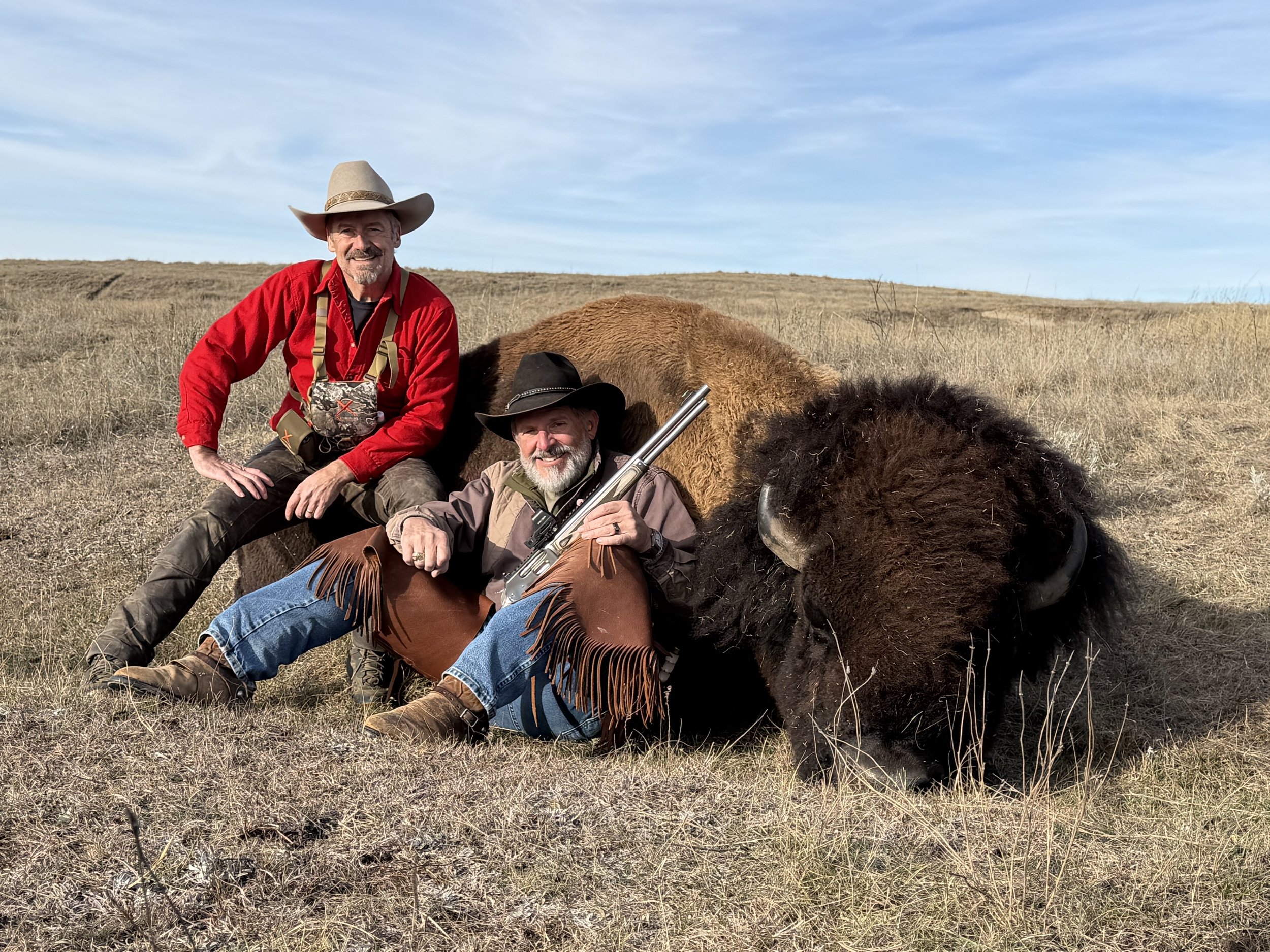
Buffalo on Horseback An Adventure on the High Plains of South Dakota
We headed out to the corral that morning to help Travis gather up a few of his cowboy horses. He explained that some of them hadn't been ridden in several months, and there was a little uncertainty as to how cooperative they might be. He had run half a dozen horses into the corral, and now the task was to catch three of them and get them saddled for the day's hunt.
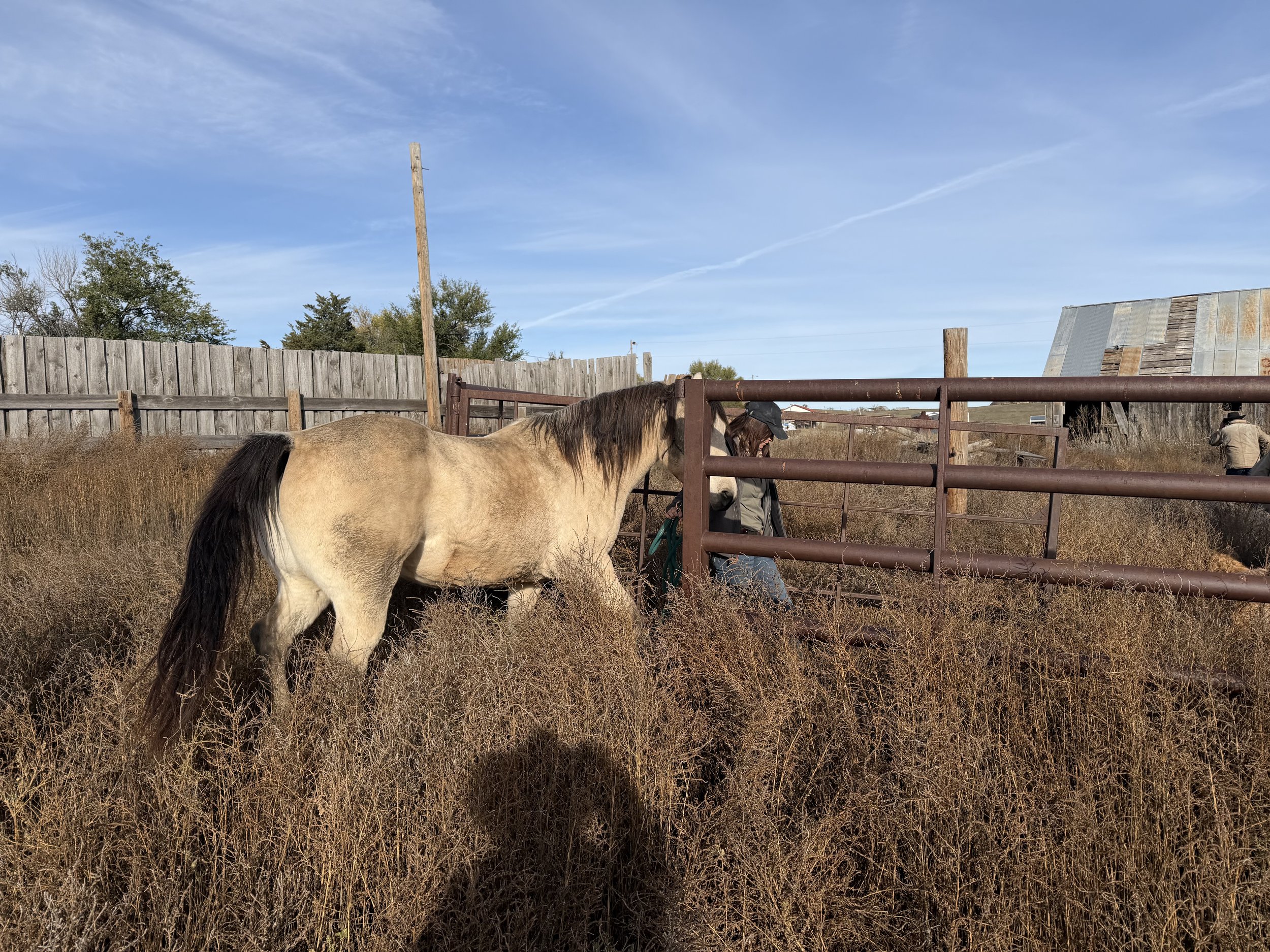
Travis stepped into the corral with his lariat, accompanied by Autumn Ryser, a young woman from Kansas who had come to assist him. There was something wonderfully authentic about watching a working cowboy rope his horses. No elaborate facilities, no unnecessary equipment, just a man, his rope, and a handful of horses that weren't particularly interested in being caught. Before long, he had caught a big buckskin and a couple of bays, and we led them out of the corral toward the ranch house.
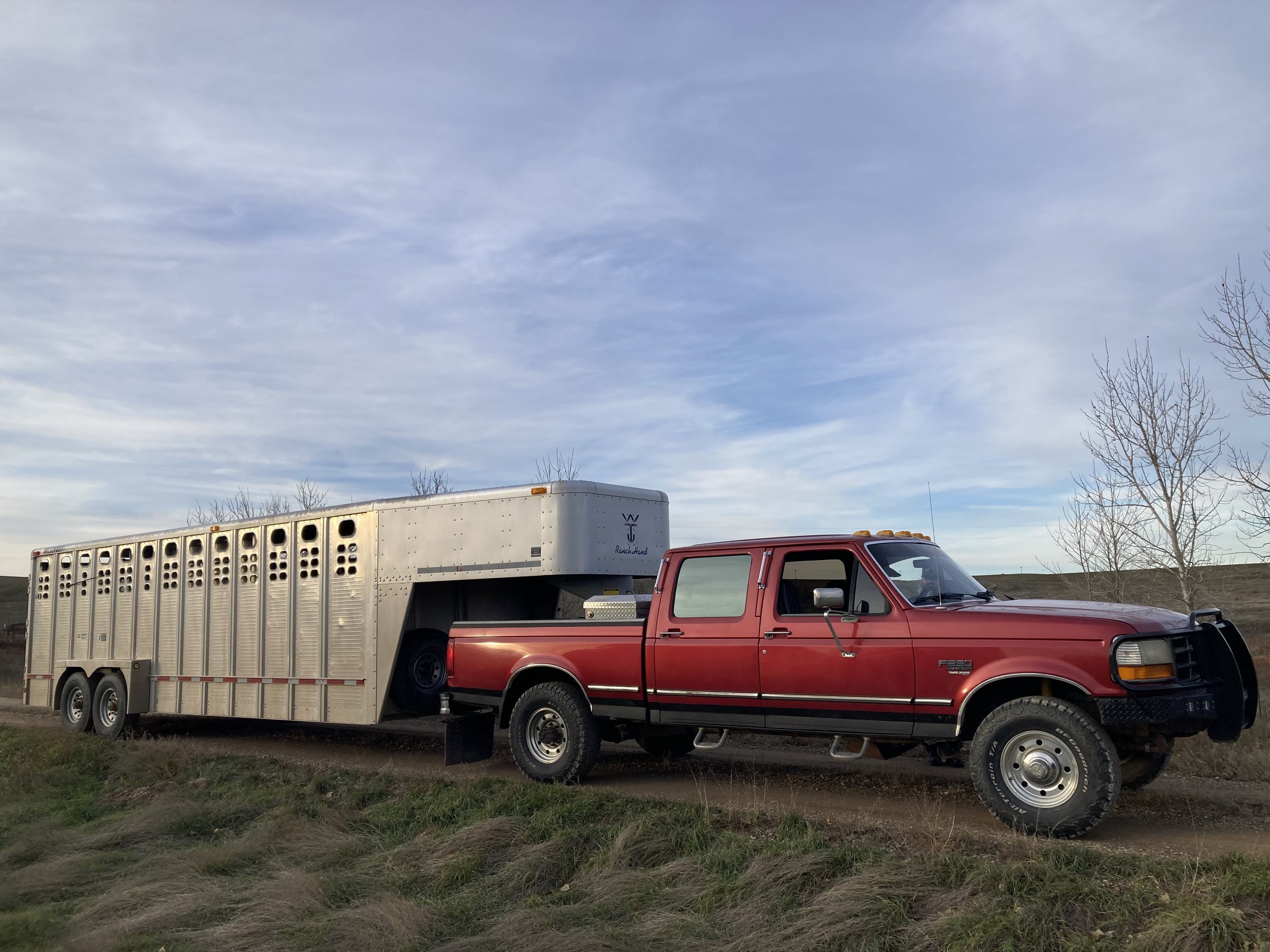
About that time, James Ingalls came rumbling up the ranch road in an old three-quarter-ton Ford diesel, pulling a gooseneck horse trailer. It was one of those vintage Ford trucks powered by the old International diesel engines, the kind of truck that seems entirely at home in cattle country. James, who is a descendant of the Ingalls family of Little House on the Prairie fame, had brought three additional horses, along with saddles and tack, and was there to help Travis with the hunt.
Travis and James were the genuine article, real cowboys, not the sort who dress the part on weekends, but men who make their living around horses and cattle. Their weathered hats, well-worn leather, boots, spurs, and easy familiarity with the horses spoke of a life spent outdoors. They looked as though they might have stepped out of an old photograph of the American West. Watching them work, I had the distinct feeling that this was going to be a special hunt.
When I first contacted Travis the previous year about arranging a horseback buffalo hunt, he had been a little apprehensive about doing it the way I envisioned. I could certainly understand his reservations. He didn't know us, had no firsthand knowledge of our shooting abilities, and couldn't be sure of our horsemanship. Hunting an animal as large and formidable as a buffalo from horseback, particularly at close range, is not something to be taken lightly.
But I had a very particular idea of how I wanted to hunt buffalo, and I wasn't especially interested in doing it any other way.
I wanted to hunt an old bull on the open range, approaching on horseback, carrying a short-barreled Marlin lever-action rifle chambered in .45/70 Government. No telescopic sight, no long-range shooting, and no modern conveniences that would take away from the experience. With my Holosun red dot site I knew I would need to get within a hundred yards to make a shot I was comfortable taking.
It was, admittedly, a romantic notion of buffalo hunting, perhaps influenced by too many old books and photographs of the American frontier. But to my mind, if I was going to travel to the northern plains to hunt the great American bison, I wanted to experience something of the country and the manner in which men had once hunted these magnificent animals. The horses, the open prairie, the old lever-action rifle, and the necessity of getting close were all part of the adventure. I wasn't simply interested in killing a buffalo. I wanted to hunt one.
Our little hunting party consisted of Travis, James, and Autumn, along with my friend Perry Cole from Birmingham, who was also hunting buffalo. Joining us were Gary Lewis and Trevor Barclay. Gary, a longtime friend of mine of some thirty years, was producing an episode for his outdoor television show, Frontier Unlimited, and Trevor was along as his cameraman to document the adventure.
There was a good deal of activity around the ranch house as we prepared the horses. Saddles were thrown over backs, cinches tightened, bridles adjusted, and rifle scabbards fitted to the saddles. Leather creaked, bits jingled, and the horses shifted impatiently as we worked. It was the sort of morning ritual that must have played out on ranches across the West for generations.
I was dressed for the occasion in my battered black cowboy hat, a faithful old companion that has accompanied me on a number of adventures, along with my leather chinks, boots, and spurs. Around my waist I wore a holstered Ruger revolver chambered in .45 Long Colt. It seemed only fitting to carry a traditional six-shooter on a hunt such as this.
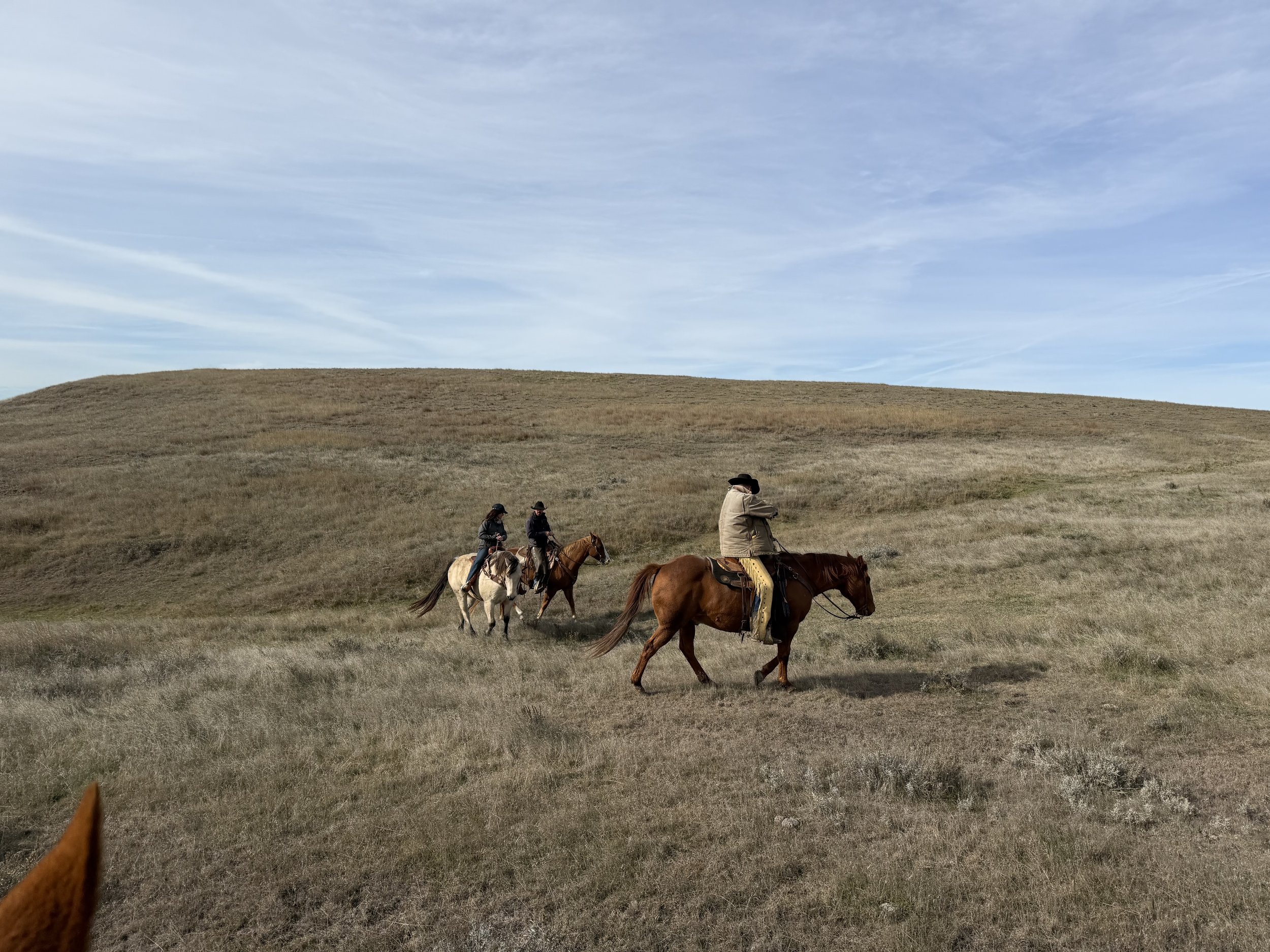
I slid my Marlin Model 1895 lever-action .45/70 into the leather scabbard, swung myself into the saddle, settled my feet into the stirrups, and gathered up the reins.
At last, we were off.
We were hunting near Mud Butte, South Dakota, in the wide-open country of the northern Great Plains. It was early November, and winter was already beginning to announce its arrival. The morning had started at about freezing, and although the temperature had climbed into the upper thirties, there was still a sharpness to the air. A light breeze moved across the prairie, carrying that cold, dry feeling peculiar to the high plains in late autumn.
The horses were fresh and a little chippy, tossing their heads and stepping out eagerly as we left the ranch behind. Some hadn't been ridden in months, and they seemed to have plenty of opinions about being put back to work. There was a certain amount of spirited behavior as we got underway, but the cowboys handled it with the calm indifference of men who had seen it all before.
The country around Mud Butte has a stark, almost deceptive beauty. At first glance, the landscape appears to be an endless expanse of gently rolling prairie, stretching away beneath an enormous western sky. The grasses had long since surrendered their summer green and taken on the muted colors of late autumn, buff, tan, dusty green, and weathered brown. There were few trees to interrupt the horizon, and the distant hills seemed to melt into one another.
From a distance, the country looks almost flat.
But once you ride out into it, you discover an entirely different landscape.
The prairie is cut by a maze of coulees, shallow draws, steep-sided ravines, and winding drainages. Low ridges rise unexpectedly from the grasslands, and what appears to be a gentle slope from half a mile away can turn into a rather abrupt descent when you reach it on horseback. The folds of the country create countless places for animals to disappear, and the broken terrain makes traveling across the plains considerably more interesting than it first appears.
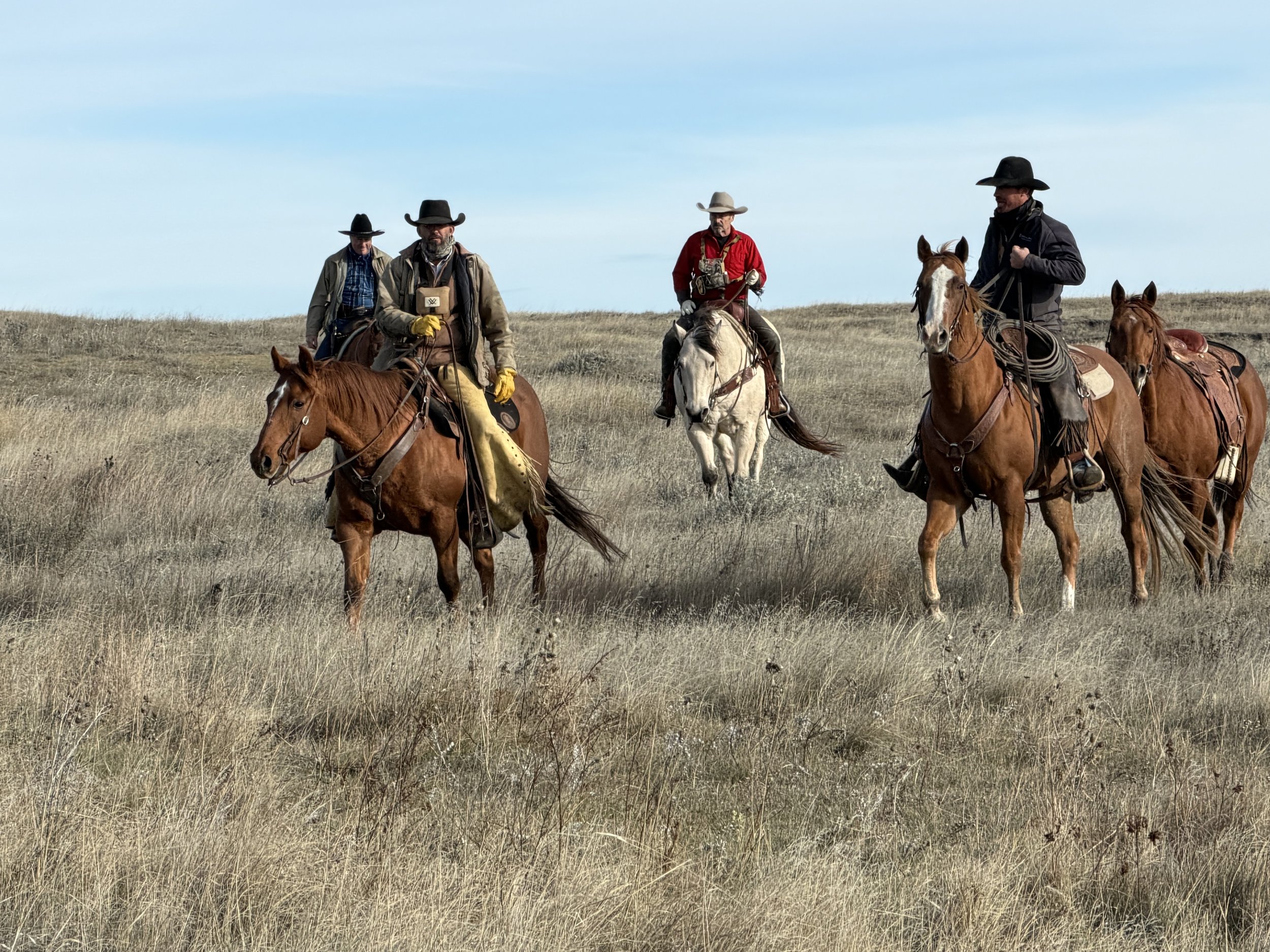
It is a landscape that rewards a man who takes the time to study it. The high ground offers tremendous views across the prairie, while the coulees and draws provide natural avenues of approach and concealment. It is also country best appreciated from the back of a horse. Traveling at that pace, with nothing but the sound of hooves, the creaking of saddle leather, and the occasional conversation among the riders, it was easy to imagine the plains as they must have appeared a century and a half earlier.
After riding for some time, we spotted the main herd of buffalo in the distance. There were several hundred animals scattered across the rolling prairie, their massive dark shapes standing out against the pale autumn grass.
It was an impressive sight.
There is something almost prehistoric about a herd of American bison. Their great shaggy heads, massive shoulders, and dark, woolly coats give them an appearance unlike any other animal on the North American continent. Seeing hundreds of them spread across the open plains, rather than confined to a pasture or viewed from a vehicle, stirred the imagination. This was the animal that had once roamed the American West in almost unimaginable numbers, and here we were, riding horseback through its country.
But we weren't looking for the main herd.
Our quarry was a smaller bachelor group of older, mature bulls. These were the big fellows, animals that had reached an age and size where they tended to separate themselves from the cows and younger buffalo. They were the sort of bulls we had come to find.
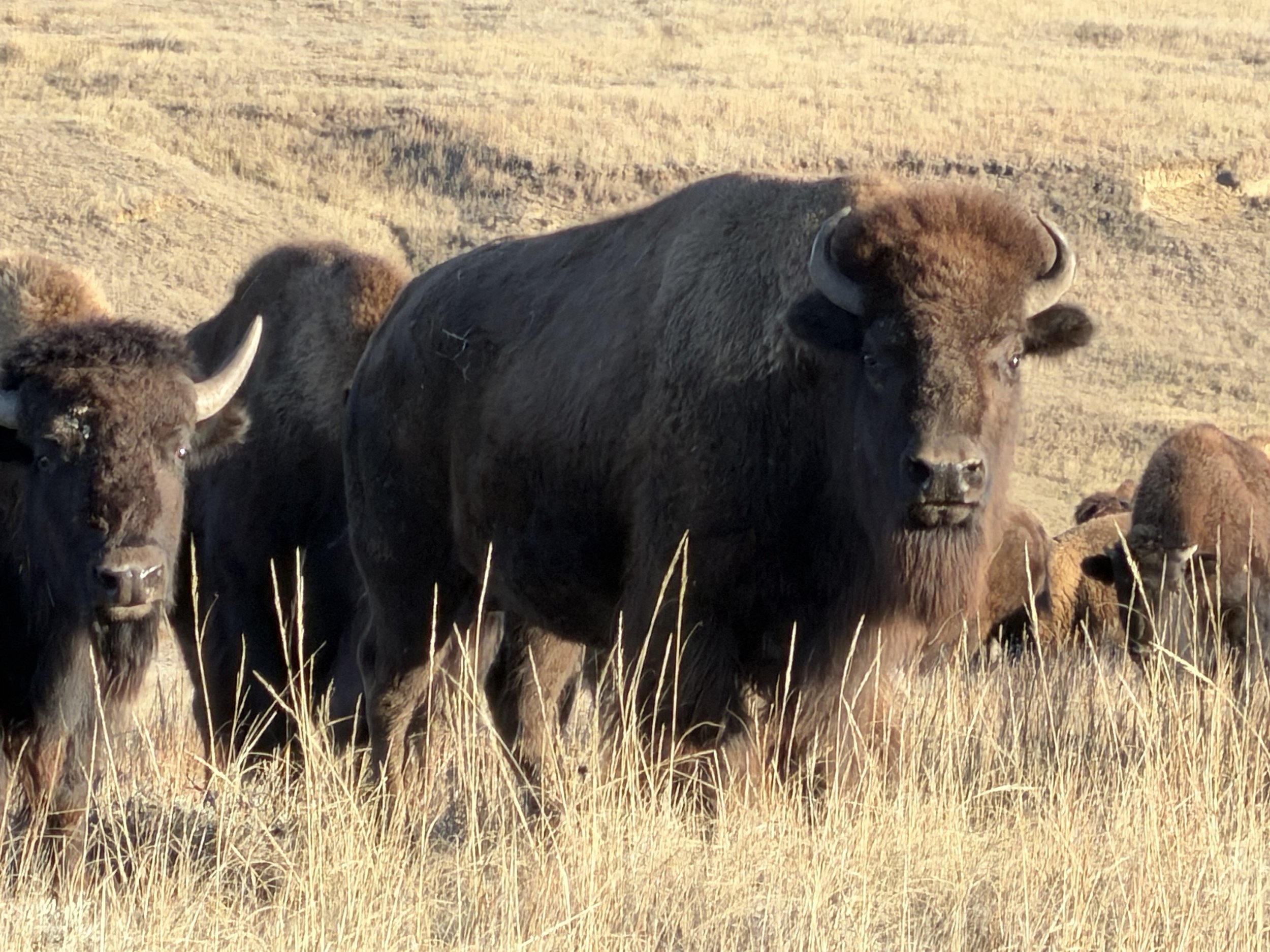
We worked our way onto the higher ridges, stopping periodically to glass the surrounding country. From those vantage points, we could see for miles across the undulating prairie. Eventually, we located the bachelor group we were looking for, several miles away.
Now the real hunt began.
We studied the lay of the land and the direction of the wind, trying to determine how best to approach without alerting the bulls. The country that had initially appeared so open and featureless began to reveal its advantages. The ridges, coulees, and shallow draws offered opportunities to move closer while remaining out of sight.
We started toward the bulls, riding carefully through the broken terrain, using the natural contours of the land to conceal our approach. Every so often we would gain a little elevation, check our position, and then drop back into the low ground. The wind was an important consideration. A buffalo's eyesight may not be its greatest defense, but its sense of smell is another matter entirely, and we had no intention of letting our scent betray us.
Gradually, we closed the distance.
Eventually, we reached a shallow ravine that appeared to offer an excellent approach. The bulls were on the other side of a low rise, and the terrain allowed us to ride up from downwind without exposing ourselves.
We dismounted, secured the horses, and slipped the rifles from their scabbards.
From this point on, we would continue on foot.
We moved cautiously up the draw, keeping low and using the rise of the ground to hide our movements. As we approached the crest, we crouched down and began easing forward. The last twenty yards were made on our hands and knees, crawling through the dry prairie grass and carefully working our way to a position where we could see over the opposite side.
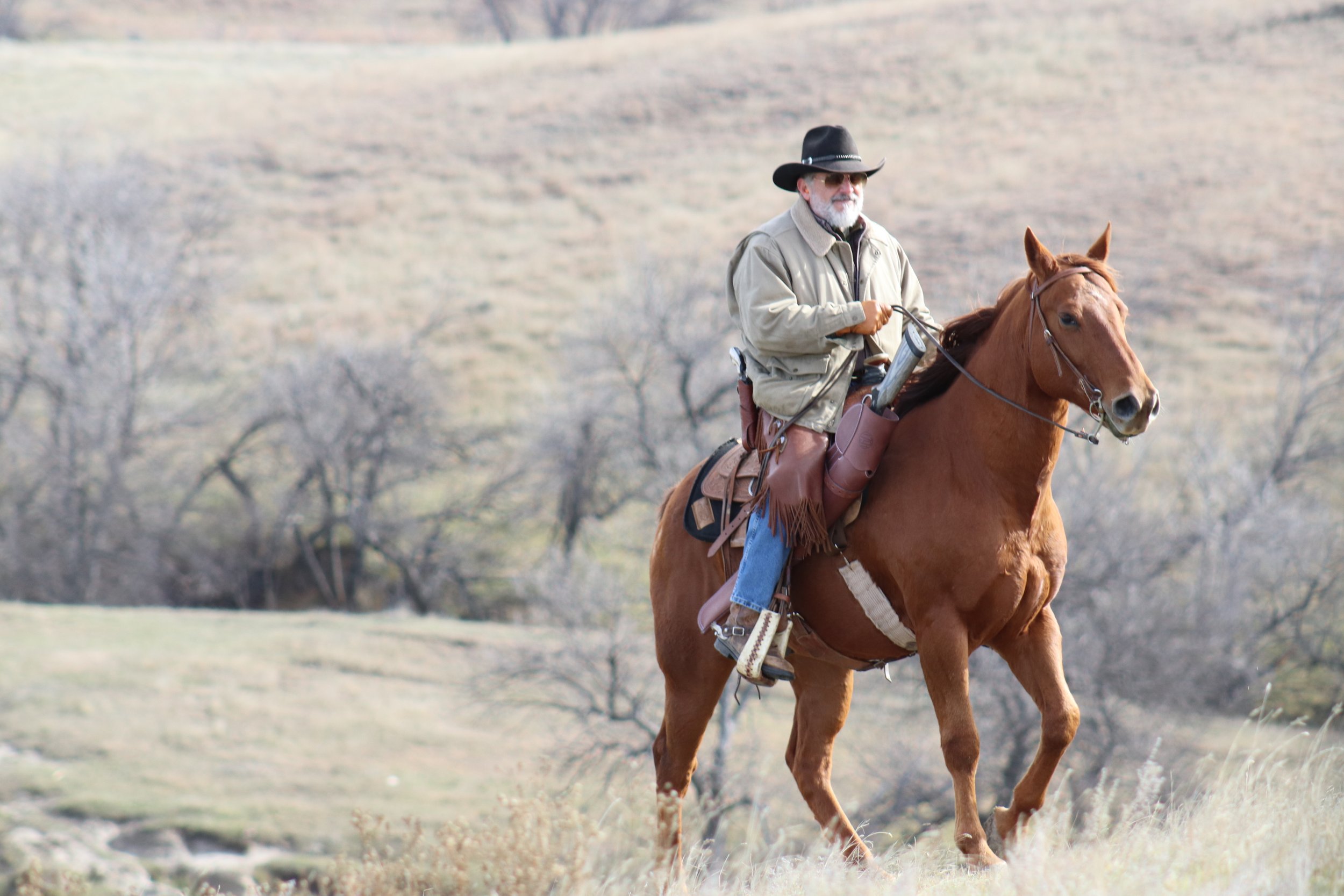
It was a wonderfully satisfying stalk. We had covered several miles on horseback, found the bulls in that vast expanse of country, and managed to approach them without being detected.
When we finally eased up high enough to look over the rise, there they were.
Eighty yards away.
The bulls were completely unaware of our presence.
I studied the group and picked out the largest animal. He was a magnificent old bull, broad across the shoulders, with the tremendous hump and heavy head that make a mature buffalo such an imposing creature.
This was exactly the sort of opportunity I had hoped for.
I eased myself up onto my knees while Travis quietly set the shooting sticks in front of me. I settled the fore-end of the Marlin into the rest and brought the rifle to my shoulder.
Through the open sights, the great bull filled my view.
I took a moment to steady myself, carefully aligned the sights, and settled them on the bull. After all the planning, the miles of travel, the early morning preparations, and the long approach across the prairie, everything had come down to this one moment.
I took careful aim and slowly squeezed the trigger.
The Marlin roared, breaking the stillness of the prairie.
I heard the unmistakable thump of the bullet striking the bull and saw a puff of dust rise from his heavy hide.
In an instant, the bulls wheeled around and began trotting away across the open country.
Travis suggested that we wait a while before following them. Buffalo are remarkably tough animals, and a mature bull weighing close to a ton can absorb a tremendous amount of punishment. I had heard the solid impact of the bullet and believed I had made a good shot, but the bull had shown little indication of being seriously wounded.
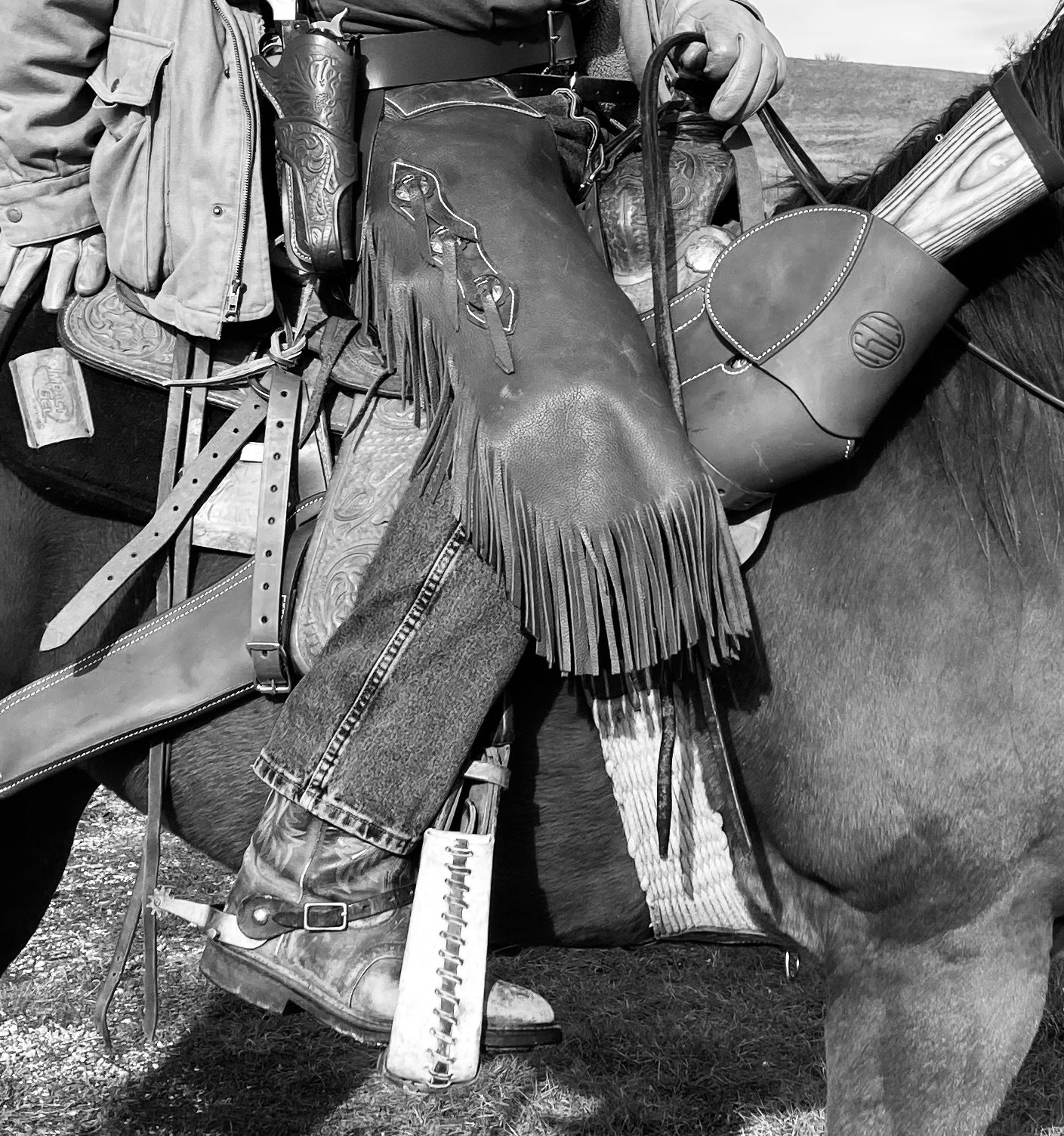
I hadn't been able to get off a second shot. With the recoil of the rifle and the sudden movement of the herd, I had lost track of the particular bull I had fired at. The last thing I wanted to do was shoot another animal by mistake. All nine bulls had moved off together, and from what I could see, none appeared to be in serious trouble.
It was not quite the outcome I had envisioned when I squeezed the trigger.
After giving the bulls some time, we returned to the horses, swung into our saddles, and started in the direction they had gone. We eventually spotted them moving across the distant prairie. All nine were accounted for, and although one seemed to be lagging slightly behind the others, he didn't appear to be badly hurt.
We continued after them.
For the next couple of hours, we followed the bulls on horseback, covering another three miles or so across the broken prairie. The animals kept moving, and the country seemed to stretch endlessly ahead of us. We would gain a ridge, locate the bulls, and then work our way through the coulees and draws in an effort to close the distance again.
As time passed, I began to grow concerned.
I had been confident of my first shot, but the longer we followed the bulls, the more I began to question it. I discussed the situation with Travis, and we both began to suspect that I might have hit the animal a little high, missing the vital organs and perhaps inflicting little more than a flesh wound.
It was a troubling possibility.
There is a responsibility that comes with hunting an animal, particularly one as magnificent as an old buffalo bull. Once I had pulled the trigger, I felt an obligation to follow through and finish what I had started. Whatever the difficulty, I wasn't about to leave a wounded animal wandering the prairie.
So we pressed on.
Eventually, we managed to locate the bulls again. They were still together, and by this time they had become thoroughly suspicious of our intentions. We stopped in a ravine some distance away and discussed how best to make another approach.
Travis and I decided that the two of us would go forward alone. With the bulls now thoroughly alerted, we thought a smaller party might have a better chance of getting close without being detected. The others remained behind while Travis and I rode ahead, once again taking advantage of the folds in the prairie to conceal our movements.
We rode as far as we dared before dismounting and hobbling the horses. From there, we continued on foot, moving carefully along the sheltered side of a low ridge.
The terrain was particularly well suited to an ambush. A rise in the ground stood above us, then sloped away to our right, eventually opening onto a broad stretch of prairie. We worked our way along the lower ground, crouching as we moved, hoping to get into position without being seen.
Suddenly, Travis caught movement on the far side of the rise.
Something was coming our way.
What I didn't know at the time was that the rest of our party had ridden around to the opposite side of the bulls. Their movement had turned the animals back in our direction, and now the herd was approaching the very ridge behind which Travis and I were concealed.
There was no time for an elaborate setup.
I quickly settled into a seated position, braced my elbows against my knees, and brought the Marlin to my shoulder. From where I sat, I could see the open country beyond the sloping ridge, and I knew the bulls would soon come into view.
Then they appeared.
The animals were moving steadily at first, but almost immediately they began to trot. Nine massive buffalo were passing through my field of view, and I had only moments to identify the bull I believed I had wounded earlier.
It was all happening very quickly.
There was no time for shooting sticks, careful adjustments, or prolonged deliberation. I had to rely on instinct and the familiarity that comes from years of handling a rifle. I have often found that I shoot better when I don't have time to overthink things, when the shot presents itself and the response becomes almost automatic.
I picked out the bull I believed was mine, swung the rifle through with his movement, settled the sights, and pulled the trigger.
The old Marlin barked again.
This time, the effect was immediate.
The great bull collapsed where he stood.
For an instant, everything seemed to stop. The other buffalo continued a short distance, then slowed and turned back toward their fallen companion. The bull struggled, attempting to regain his feet, but he could not rise.
Travis urged me to shoot again, but the other bulls had gathered around him, standing close and looking back at the fallen animal. I couldn't risk another shot with the possibility of striking one of them.
We waited.
There was something remarkable about watching those enormous animals standing around the fallen bull. They seemed reluctant to leave him, and for a few moments we could do nothing but watch and wait for them to move away.
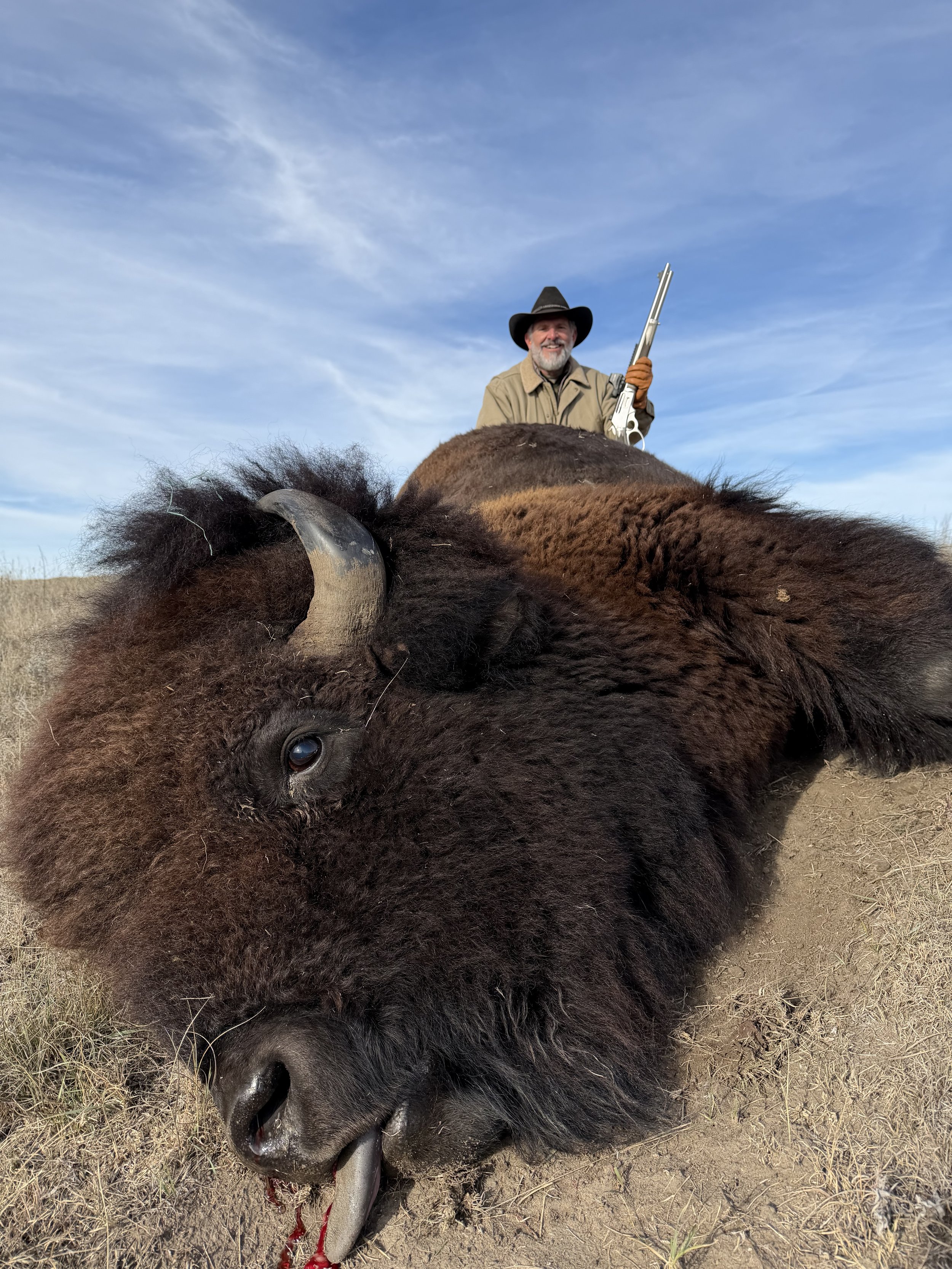
Eventually, the others drifted off, leaving the old bull behind.
Travis and I cautiously approached.
Even lying on the ground, he was an astonishing sight. His massive shoulders rose above the prairie grass, and his great shaggy head seemed almost impossibly large. As we drew closer, he gave a slight kick, and it was apparent that he was not quite finished.
I drew the Ruger .45 Colt revolver from my holster and administered the final shot.
Then it was over.
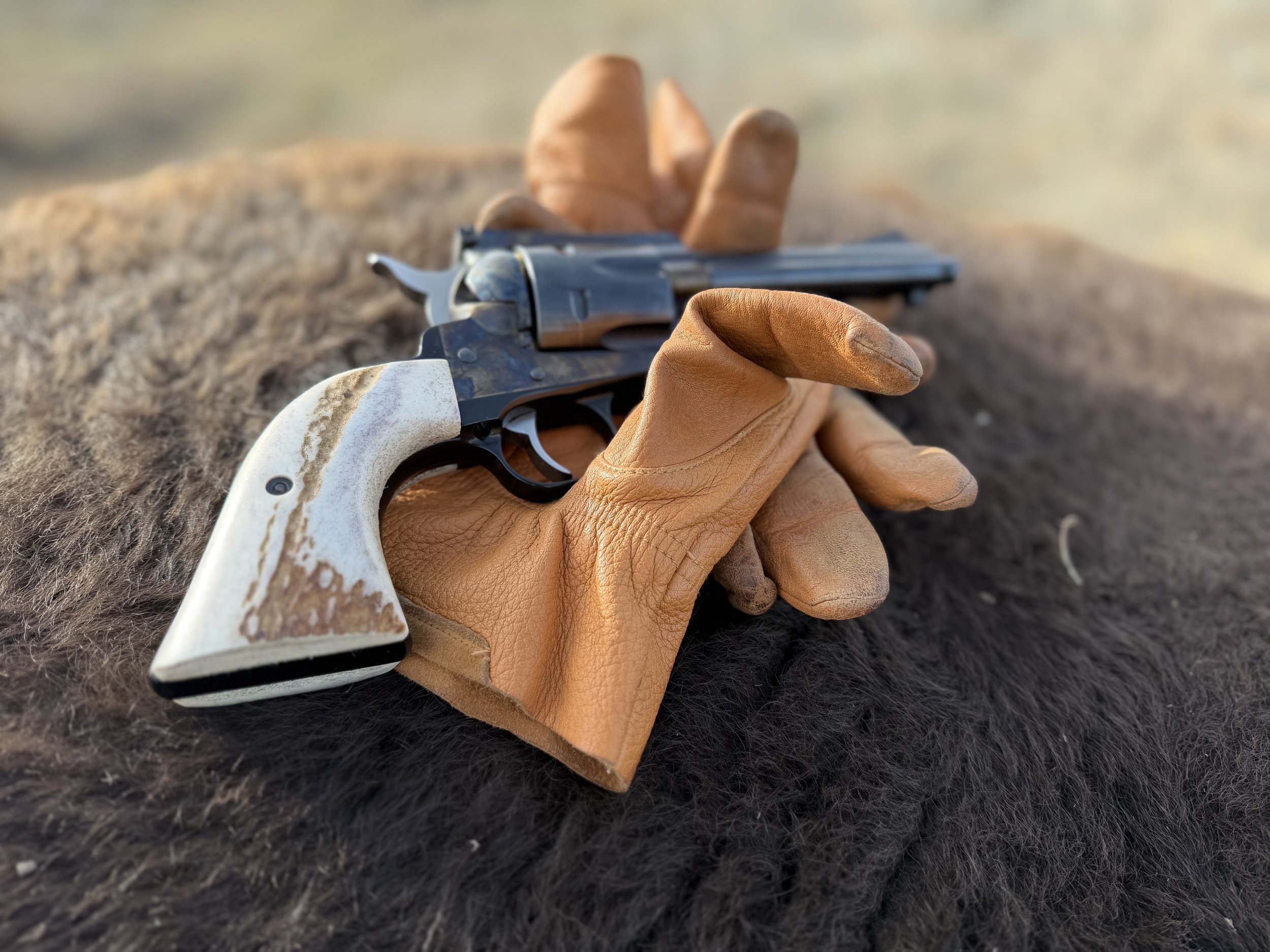
I stood for a moment looking at him.
He was enormous.
We estimated that the old bull weighed somewhere in the neighborhood of 2,000 pounds. His head alone seemed larger than my entire upper body, and his massive hump, thick neck, and heavy coat gave him the imposing appearance that only a fully mature buffalo bull possesses. He was a fine old trophy, exactly the sort of animal I had hoped to find when I first began planning the hunt.
I walked around him slowly, taking in his tremendous size and studying the features that made him such a remarkable animal. There was something humbling about standing beside a creature of that magnitude, an animal so closely tied to the history of the American West.
I also confirmed that the first shot was high, narrowly missing the lungs, and only a flesh wound in the hump.
I thought back over the events of the day.
The early morning preparations at the ranch, the cowboys roping their horses, the cold November air, and the miles we had ridden across that vast and broken country. I remembered the first sight of the great herd scattered across the prairie, the long stalk through the coulees, and the excitement of finding those old bulls just eighty yards away.
And, of course, I thought about the shot that hadn't gone quite as planned and the long, uncertain pursuit that followed.
It had not been an easy hunt, nor had it unfolded exactly as I had imagined. But perhaps that was part of what made it so memorable. Hunting rarely follows a script, and the unexpected difficulties are often what turn an ordinary outing into a genuine adventure.
I had come to South Dakota with a particular dream. I wanted to hunt an old buffalo bull on horseback, in open country, carrying a traditional lever-action rifle. I wanted to experience something of the way the old buffalo hunters had known the plains, when a horse was the means of travel and getting close to the quarry was an essential part of the hunt.
And now, standing beside this magnificent old bull, I realized that I had done exactly that.
It was a dream fulfilled.
Before long, the rest of our party arrived, and the quiet moment gave way to the excitement and congratulations that naturally follow a successful hunt. Perry, Gary, Trevor, James, and Autumn joined us as we admired the bull, exchanged stories of the final stalk, and took photographs to preserve the occasion.
There was plenty to talk about. Everyone had experienced the hunt from a slightly different perspective, and it was interesting to hear how the final events had unfolded, particularly how the others had unknowingly helped turn the bulls back in our direction.
Gary and Trevor had been along to document the adventure for Frontier Unlimited, and I was pleased that they had been there to share the experience. But beyond the photographs and television footage, I knew the memories of the day would remain with me long after the details of other hunts had begun to fade.
Travis eventually mounted his horse and headed back toward the ranch to retrieve the recovery vehicle. We still had the considerable task of getting a nearly one-ton buffalo out of the prairie and back to the ranch, where the work of processing the meat and preparing the hide could begin.
And with an animal that size, there was going to be plenty of work.
As I stood there waiting, looking out across the rolling South Dakota prairie, I couldn't help but reflect on how fortunate I was to have experienced such a hunt. The horses, the cowboys, the wide-open country, and the magnificent old bull had all come together to create something that felt like a small step back into another era.
It was the kind of adventure I had hoped for when I first called Travis the year before, though I could never have predicted quite how it would unfold.
The real work was still ahead of us, but for the moment I was content to stand there, taking in the country and the old bull lying in the grass.
I had come to the northern plains hoping to experience a little of the American West as it once was.
And for one cold November day in South Dakota, I believe I had.
It was a hunt I will remember fondly for the rest of my life.